
The Cabinet Door Problem: Why "Control" and "Responsibility" Are Not the Same Job
There's a moment that shows up in almost every operations leader's week, and it usually looks small. A cabinet door falls off its hinge. A ceiling starts leaking onto the dining room floor. Someone needs an answer in the next ten minutes, and the person best equipped to give it is you.The Cabinet Door Problem: Why "Control" and "Responsibility" Are Not the Same Job
There's a moment that shows up in almost every operations leader's week, and it usually looks small. A cabinet door falls off its hinge. A ceiling starts leaking onto the dining room floor. Someone needs an answer in the next ten minutes, and the person best equipped to give it is you.
You fix it. Of course you do. It's the right call at the moment.
But if that pattern repeats itself often enough, if you are the one always reaching for the screwdriver, always catching the falling door, it's worth asking a harder question: is this actually your job, or is it just the job you keep picking up because no one else will?
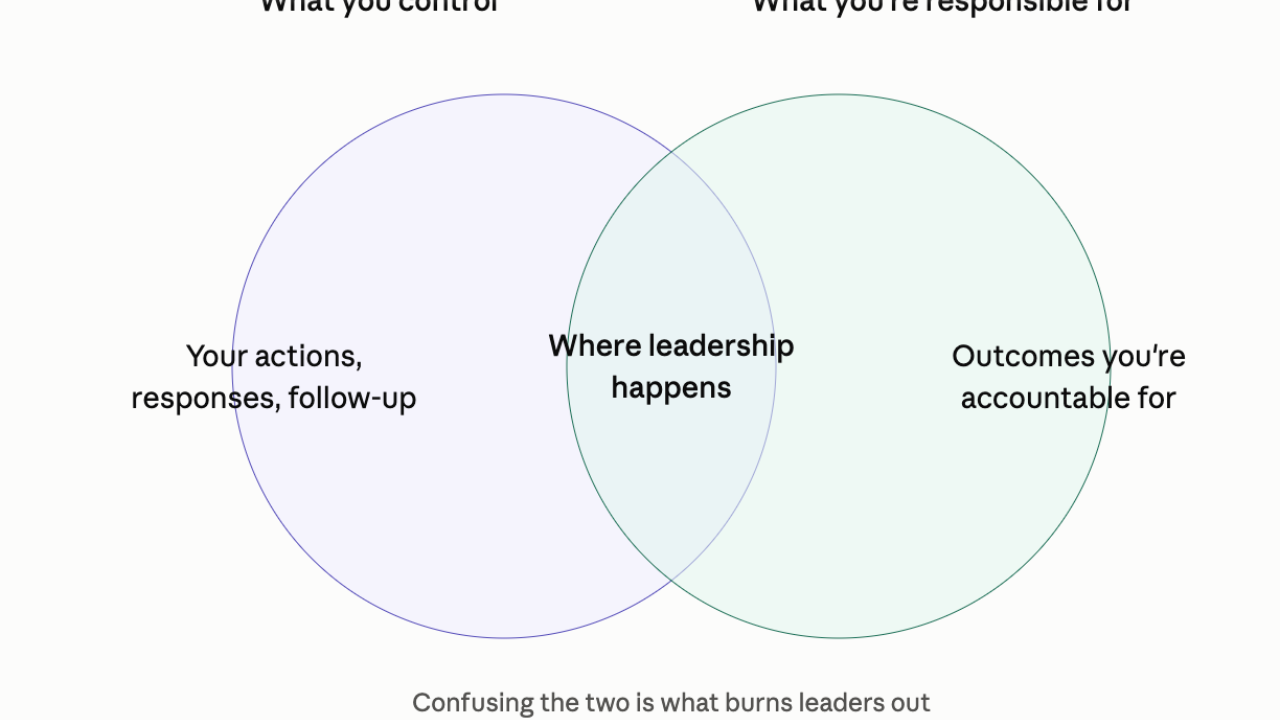
That question sits at the center of a distinction that quietly separates burned-out operators from clear-headed leaders: the difference between what you control and what you are responsible for.
A Composite Case: The Manager Who Kept Rescuing Everything
Consider a manager, call him the Operator, who runs day-to-day operations across two small hospitality businesses. He's good at his job precisely because he's the kind of person who steps in: a pipe bursts, he calls the contractor; a cabinet door falls off mid-shift, he grabs a screwdriver; a training session has no plan behind it, he builds one, even though nobody assigned it to him.
In a coaching conversation, he describes a new personal system he's testing: blocking uninterrupted time on his calendar to protect focused work, instead of always being available to whoever needs him first. It's a good instinct. But even as he describes it, his language keeps slipping into hedges, "I have a plan, but," "I hope it works," "maybe they'll figure it out before I'm available."
His coach catches the pattern immediately: every time he states something powerful, he immediately undercuts it. He says he's built a six-week structure for protecting his time, then adds a "but" that quietly hands the power back to circumstance. The coach doesn't let it slide. She has him say the sentence again, without the qualifier, and asks him to notice what changes.
That small edit opens up the real conversation. Because underneath the time-management question is a bigger one: the Operator has taken on responsibility for outcomes - the ceiling leak, the employee handbook, an entire sales training nobody clearly assigned him - while feeling like he has no actual control over the decisions driving those outcomes.
The clearest example is the employee handbook. A co-owner sends over a revised draft and asks him directly: can we finish this before an upcoming training date, and how do you want to handle edits? His response is a single line offering to meet. Days pass. No meeting happens. When the coach asks who's responsible for creating urgency, the Operator's first instinct is to describe everything he doesn't control - the co-owner's silence, her schedule, the ambiguity about who initiated the whole training in the first place.
The coach reframes it in one sentence: it is your job to get the handbook done. You can't control whether she responds. You can control whether you follow up, how directly you ask, and whether you let ambiguity sit unresolved.
By the end of the session, the Operator lands somewhere useful. He can't control what the co-owners decide about PTO policy, or whether they respond to his emails, or whether a training session was well thought-through before it landed on his plate. What he can control is his own follow-up, the clarity of his communication, and - critically - whether he keeps quietly absorbing ownership of things nobody actually assigned to him.
Why This Distinction Matters
Most operators don't fail because they lack competence. They struggle because they've stopped separating two very different questions:
- What is mine to decide, act on, or respond to right now? (Control)
- What outcome am I ultimately accountable for delivering? (Responsibility)
Responsibility without control is exhausting - you feel the weight of an outcome you can't fully drive. Control without accepted responsibility creates chaos - decisions get made with no one owning what happens next. The healthiest working relationships constantly clarify the overlap between the two, out loud, instead of leaving people to guess.
When that clarity is missing, a predictable failure pattern shows up: the most conscientious person in the room starts absorbing responsibility for things they don't control, because leaving them undone feels worse than quietly fixing them. Over time, this looks like dedication. It's actually a system slowly training its best people to do everyone else's job.
Takeaways for Business Owners
- Silence is a decision - treat it that way. When a manager asks a direct question and doesn't get an answer, the business doesn't pause. The manager either stalls the project or makes the call unilaterally. If you want to stay in control of a decision, respond to the people who are waiting on you. Unanswered emails don't preserve your authority; they just transfer decision-making downstream without ever officially handing it off.
- Notice when someone is doing a job that isn't theirs - and ask why. If a manager is signing vendor contracts, planning events, or writing policy documents that fall outside their role, that's not automatically a compliment to their initiative. It's often a sign that ownership was never clearly assigned, and someone stepped into the vacuum because the alternative was nothing getting done. Left unaddressed, this creates quiet resentment and blurred accountability on both sides.
- Give clear answers to specific questions, not general direction. "Let me know how you'd like to proceed" is not the same as a decision. If a manager asks a yes/no question, answer it as a yes/no question. Every open loop you leave behind becomes something someone else has to manage - usually by either chasing you or guessing.
Takeaways for Managers and Operators
- Listen for your own qualifiers. "I have a plan, but..." "I hope it works." "Maybe they'll figure it out." These aren't neutral phrases - they're the sound of you quietly handing your own authority back to chance. Try finishing the sentence without the hedge and notice what it commits you to. That discomfort is often exactly where your real leverage is.
- Separate "I have to handle this" from "this is actually mine." Some things genuinely can't wait - a safety issue, a customer standing at the counter, water on the floor. Handle those. But recurring situations - a policy document, a training plan, a project someone else started and abandoned - deserve a different question: whose job is this, actually, and have I ever said so out loud? If the answer is unclear, that ambiguity is worth resolving directly, not absorbing silently.
- Create urgency instead of waiting for it. If you need a decision and you're not getting one, the fix is rarely to wait more patiently. State the deadline, propose the specific time, and say plainly that you haven't heard back. This isn't confrontation - it's just making the ask as clear as the ones you'd make to solve a problem in the middle of a shift, where you'd never hesitate to be direct.
- Protect your time on paper, then defend it in practice. Blocking time for focused work only functions if you actually treat it as a boundary - including the uncomfortable early stretch where problems pile up because people are used to catching you immediately. Expect some friction. It's not evidence the system is failing; it's evidence the old system is finally being replaced.
The Bottom Line
You are not responsible for everything you're capable of fixing. And you don't control everything you're responsible for. The work - for owners and managers alike - is naming that gap honestly, out loud, on a regular basis, instead of letting one person quietly absorb it in silence.
The cabinet door will always need someone to notice it. The real leadership question is whether that person is chosen, or just the one who happened to be standing there again.
SUBSCRIBE FOR MONTHLY TIPS AND TRICKS!
Great Mann Group content, right to your inbox.
We hate SPAM. We will never sell your information, for any reason.
